
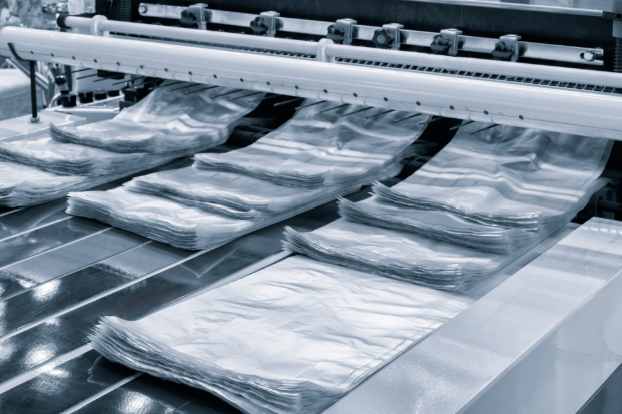
Order poly bags too small, and your product won’t fit, or the seams give out in transit. Order them too big, and you’re paying for wasted film, higher dimensional weight charges, and inconsistent results on automated lines.
Getting poly bag size right isn’t just a measuring exercise anymore. It’s a cost, efficiency, and sustainability decision that shows up on your bottom line.
This guide walks through how to measure your product, choose the right sizing allowance, pick the correct bag style, and confirm your size before committing to a full production run.
We’ll also cover how sizing choices affect shipping costs, material waste, and compatibility with automated bagging equipment, because in 2026, “what size poly bag do I need” is really a question about packaging efficiency as a whole.
Key Takeaways:
- Measure length, width, and depth, then add a sizing allowance. Don’t match bag size to bare product dimensions.
- Retailers can cut plastic packaging costs 15% on average, and up to 40% in some categories, by using right-size packaging.
- Bag style (flat, gusseted, or on a roll) affects fit and automation compatibility as much as dimensions do.
- Always request a physical proof before running a full production order.
What Is a Poly Bag?
A poly bag is a flexible plastic bag made from polyethylene film, used to package, protect, or ship products of nearly any shape or size.
Manufacturers choose thickness (measured in mils), style (flat, gusseted, or on a roll), and exact dimensions of poly bags based on the product and how it will be packed, shipped, or fed into automated equipment.
How Do You Measure a Poly Bag?
To measure for a poly bag, measure your product’s length, width, and depth (or height) at its widest points, then add a sizing allowance on top of those numbers. Skipping the allowance is the single most common sizing mistake procurement teams make.
Work through it in order:
- Length: the longest dimension, measured end to end.
- Width: the shortest dimension, measured side to side.
- Depth or height: how far the product extends when it’s loaded flat or upright.
- Irregular shapes: measure at the widest point in each direction, not an average.
For soft or flexible products, like apparel, textiles, or foam, measure them in their natural, unstretched state.
For rigid products, account for any protruding hardware, labels, or inserts that add to the footprint.
Sound simple? It is, until step two gets skipped and the allowance never happens.
How Much Larger Should a Poly Bag Be Than the Product?
As a general rule, add 10% to 20% to your product’s length and width, or a flat 1 to 3 inches per side for smaller items, so the bag isn’t fighting your product on the packing line.
That allowance shifts depending on how the bag gets used:
- Snug retail fit: add 1–2 inches to width and length.
- Bulk or multi-item packing: add 2–4 inches to allow for stacking and hand-loading.
- Automated bagging lines: add enough clearance for the bag to open and seat consistently in the machine, typically a bit more than a hand-packed bag needs.
Our Take: The biggest sizing mistake we see isn’t measuring the product wrong. It’s measuring the product and ignoring how it will be packed. A bag sized for hand-packing often jams on an automated line, no matter how accurate the original measurement was.
What Are the Standard Poly Bag Sizes?
Standard poly bag sizes run from small parts bags around 2″ x 3″ up to bags exceeding 40″ x 48″ for bulky or industrial items, but most manufacturing and fulfillment orders fall into a handful of common ranges.
Wondering why a size chart can only get you so far? Real products rarely land on a chart’s round numbers exactly, which is why the allowance rules above still matter.
Common Poly Bag Sizes by Product Type
| Product Type: | Typical Flat Size (W x L): | Common Thickness: | Bag Style: |
| Small parts and hardware | 2″ x 3″ – 6″ x 9″ | 1.5–2 mil | Flat |
| Apparel and soft goods | 9″ x 12″ – 14″ x 20″ | 1.5–2 mil | Flat or gusseted |
| Electronics and components | 6″ x 8″ – 12″ x 15″ | 2–4 mil, anti-static | Flat |
| Food-contact items | 4″ x 6″ – 12″ x 18″ | 1.5–3 mil | Flat or gusseted |
| Bulky or irregular products | 18″ x 24″ – 40″ x 48″ | 2–6 mil | Gusseted |
| High-volume automated packing | Custom to machine specs | 1–3 mil | On a roll (wicketed or continuous) |
These ranges are starting points, not defaults. If you’re unsure which thickness fits your product and equipment, our mil thickness guide breaks down gauge selection by application.
Choosing the Right Poly Bag Type
Size only tells half the story. The type of poly bag you choose determines how well that size actually performs on your line.
- Flat poly bags: the simplest construction, best for uniform, non-bulky products.
- Gusseted poly bags: expandable side or bottom panels that add depth for irregular or bulky items without needing a larger flat size.
- Our guide to specialty poly bags covers gusseted, anti-static, and UV-resistant options in more depth.
- Bags on a roll (including wicketed): pre-sized bags fed continuously or in stacks, purpose-built for automated and semi-automated bagging equipment.
Matching bag style to your packing method, hand-packed or automated, matters just as much as the dimensions themselves.
How Does the Right Poly Bag Size Cut Packaging and Shipping Costs?
Right-sizing your poly bags reduces material waste and can lower dimensional weight shipping charges by shrinking a package’s outer footprint. In fact, a report found that retailers implementing smarter, right-sized packaging strategies cut their plastic packaging cost base by 15% on average, and up to 40% in some categories.
For shipped goods, even a half-inch of unnecessary bag length across thousands of units adds up fast in film cost and carrier surcharges.
Sustainability and Poly Bag Sizing
Packaging waste is a real line item, not just a talking point. According to U.S. Environmental Protection Agency data, containers and packaging account for 82.2 million tons of waste, 28.1% of total municipal solid waste generation, in the agency’s most recent reporting. Every bag sized closer to the product, instead of padded out of caution, is fewer tons headed toward that total.
Pairing the right dimensions with the right film thickness, sometimes called downgauging, is one of the fastest ways to cut material use without changing your bag size at all. Our guide to reducing packaging waste in manufacturing covers additional strategies.
Our Take: Sustainability and cost savings point the same direction here. Right-sizing isn’t a trade-off between doing right by the planet and doing right by your budget. Most of the time, it’s the same decision.
Are Your Poly Bags Ready for Automated Packaging Lines?
Automated and semi-automated bagging equipment needs tighter size tolerances than hand-packing does, because the machine seats and seals every bag the same way, with no one to correct small variations.
According to a 2026 IndexBox market analysis, e-commerce fulfillment is now the fastest-growing segment of the automated poly bagging machines market, holding 22% of demand as more operations shift to systems built for variable product sizes.
Bags on a roll, especially wicketed styles, are built for exactly this. Consistent width, consistent hole placement, and tight dimensional tolerance keep a bagging machine running without jams or misfeeds. Our guide to wicketed poly bags explains how they’re used on automated lines.
Still packing by hand but eyeing automation? Size tolerance is one of the first specs to lock down before you invest in equipment.
How Do You Confirm Your Poly Bag Size Before You Order?
Before committing to a full production run, request a physical proof, a sample bag built to your exact specifications, and test it with your actual product.
- Load the product into the sample the way it will be packed in production.
- Run it through your sealing, bagging, or labeling equipment, if applicable.
- Check fit at both the loosest and tightest points of your product’s size range, if it varies.
- Confirm the thickness holds up under your shipping and handling conditions.
A proof catches sizing problems on one bag instead of ten thousand.
Request a free sample of your custom poly bag size before placing a full order →
Frequently Asked Questions: Choosing Poly Bag Sizes
What size poly bag do I need?
The right size poly bag for your product equals your product’s length, width, and depth, plus a sizing allowance of 10–20% (or 1–3 inches per side), so the bag fits without stretching tight or leaving excess slack.
How do you measure a poly bag?
Measure the flat, unfolded width and length of the poly bag. For gusseted bags, the gusset (the side or bottom fold) is measured separately and adds to total capacity, not to the flat width or length.
How much larger should a poly bag be than the product?
Add roughly 10–20% to length and width for most products, or 2–4 inches for bulky items packed on automated lines, so the bag seats and seals consistently.
What’s the difference between a poly bag and a poly mailer?
A poly bag is a general-purpose flexible plastic bag used to package or protect a product. A poly mailer is a specific type built with a self-sealing adhesive strip, designed for shipping rather than interior packaging.
What mil thickness should I use for a poly bag?
Light products typically work with 1–2 mil film, while heavier, sharp-edged, or industrial items need 3 mil or higher. Our mil thickness guide breaks this down by product type.
Are poly bags recyclable?
Most polyethylene poly bags are recyclable through store drop-off programs for film plastics, though standard curbside recycling typically doesn’t accept them due to sorting equipment limitations.
Can I get poly bags in a custom size?
Yes. Most manufacturers, A-Pac included, produce poly bags in fully custom dimensions, thicknesses, and styles built to your exact specs rather than limiting you to stock sizes.
Why Order Your Poly Bags From A-Pac Manufacturing?
Getting the size right on paper is one thing. Getting it right on your line, at volume, order after order, is the harder problem, and it’s the one A-Pac solves.
As a domestic manufacturer, A-Pac Manufacturing builds poly bags to your exact dimensions, thickness, and style rather than pushing you toward the nearest stock size, and produces a physical proof before any full production run so sizing issues get caught early, not after ten thousand bags ship.
That matters most for the buyers this guide is written for: procurement teams juggling multiple SKUs, operations managers fitting bags to automated lines, and manufacturers who can’t afford a size mismatch holding up a shipment.
A-Pac’s in-house production means custom orders, including gusseted, wicketed, and bags-on-a-roll formats built for automated equipment, don’t have to wait on a third party.
Talk to an A-Pac packaging specialist about custom poly bag sizing, or request a quote for your exact specs →
