
Medical Packaging Bags: Meeting WHO Standards & Zero-Defect Requirements
What happens when a pharmacy bag splits at the seam? Or when a specimen bag leaks in transit? In most industries, a packaging failure costs money. In healthcare, it can cost a diagnosis, a dose, or someone’s safety.
That’s why medical packaging bags have to do three things, every single time:
- Stay clean and non-reactive with whatever they hold
- Protect the contents from light, moisture, oxygen, and temperature swings
- Perform exactly as specified, with zero defects
Below, we cover what the World Health Organization (WHO) expects from pharmaceutical packaging, the five bag types clinical teams rely on most, and how to tell a reliable manufacturer from a risky one.
Key Takeaways:
- WHO’s packaging guidelines call for packaging that protects contents from light, moisture, oxygen, and temperature without reacting with them.
- Pharmacy, sterilization, 3-wall specimen, water-soluble, and transfer bags each solve a different clinical risk.
- A-Pac makes custom polyethylene medical packaging bags under ISO 9001:2015 and FSSC 22000 certifications.
What Are the Pharmaceutical Packaging Requirements Set by WHO?
WHO requires pharmaceutical packaging to protect the product, stay compatible with it, keep patients and handlers safe, and work as intended through storage, transport, and use. Those principles come from the World Health Organization’s Guidelines on Packaging for Pharmaceutical Products, published as Annex 9 of Technical Report Series No. 902.
The 4 Core Packaging Principles
- Protection: Shields the contents from environmental damage
- Compatibility: Doesn’t react with or contaminate the product
- Safety: Protects patients and the staff who handle the package
- Function: Opens, seals, and performs the way it’s supposed to
The 4 Environmental Threats Packaging Must Block
So what does “protection” mean for a plastic bag? It comes down to four threats:
- Light: UV and visible light can break down photosensitive drugs and compounds.
- Moisture: Humidity can degrade tablets, clump powders, and weaken paper labels.
- Oxygen: Oxidation shortens shelf life and can change how a product works.
- Temperature: Swings during shipping and storage can push products outside their stable range.
Definition: Non-reactive packaging
Packaging made from materials that won’t leach chemicals into, absorb from, or chemically interact with the product they hold.
WHO’s Guidelines on Packaging for Pharmaceutical Products say packaging must provide protection, compatibility, safety, and function. For medical packaging bags, that means the film itself has to block threats like light and moisture while staying chemically inert against the medications, samples, or materials inside.
Why Do Medical Packaging Bags Need a Zero-Defect Standard?
Medical packaging bags need a zero-defect standard because a packaging flaw in healthcare is a safety event, not a cosmetic issue. One weak seal or pinhole can ruin a sample, expose staff to contamination, or reveal private patient information.
What a Single Defect Can Cause:
- Compromised specimen integrity: A leaking or contaminated sample may have to be redrawn, or it may produce an unreliable result.
- Staff exposure: Torn liners and failed closures put hands in contact with infectious material.
- Privacy breaches: A see-through or torn pharmacy bag can reveal a patient’s medications.
- Failed audits: Inconsistent packaging is a compliance finding waiting to happen.
Our Take: You can’t inspect zero defects into a bag at the end of the line. They’re built in through:
- Controlled extrusion that keeps film thickness and strength consistent
- Consistent seal settings on every run
- Documented material lots
- Traceability that ties every bag back to the production run it came from
What Are the 5 Types of Medical Packaging Bags?
The five most common medical packaging bags are pharmacy bags, sterilization bags, 3-wall specimen bags, water-soluble laundry liners, and transfer bags. Each one is built around a specific clinical risk, from patient privacy to infection control.
Types of Medical Packaging Bags |
|||
|---|---|---|---|
| Bag Type | Primary Use | Key Feature | Common Material |
| Pharmacy bags | Dispensing prescriptions | Opaque privacy, tamper-evident seal | HDPE |
| Sterilization bags | Holding items through sterilization | Lets the sterilizing agent reach the contents | Film rated for the method |
| 3-wall specimen bags | Transporting clinical samples | Leak-resistant layers, HAZARD printing | LDPE / LLDPE |
| Water-soluble liners | Containing contaminated linens | Dissolves in hot wash water | Water-soluble film |
| Transfer bags | Moving items between departments | Strong adhesive closure | LDPE |
1. Pharmacy Bags
Pharmacy bags keep prescriptions private and secure from the counter to the patient’s home.
- Opaque HDPE: Nobody in the waiting room or parking lot can see what a patient picked up.
- Tamper-evident seals: These show right away if a bag has been opened.
- Custom printing: Add branding, instructions, or regulatory notices.
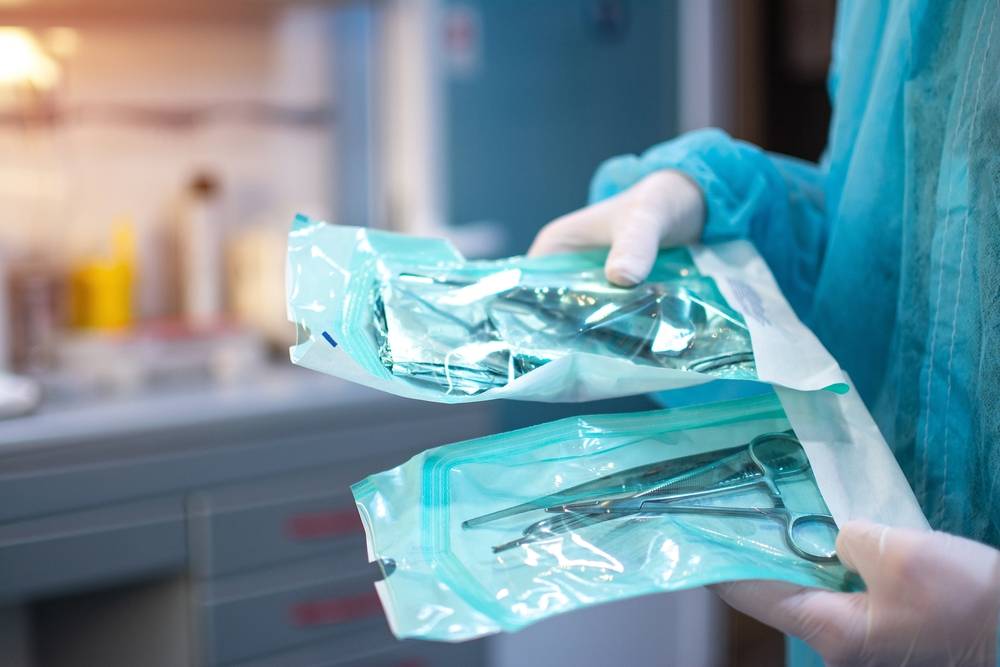
2. Sterilization Bags
Sterilization bags let heat, steam, or vapor reach the contents, then keep those contents protected after the cycle ends.
- Method-specific design: Steam, ethylene oxide, and low-temperature vapor each put different demands on the film.
- Post-cycle protection: The bag keeps contents sterile until use.
- Buyer tip: Before you write a spec, ask any supplier which sterilization methods their bags are validated for.
3. 3-Wall Specimen Bags
3-wall specimen bags add layers of leak resistance for transporting blood, tissue, and other clinical samples.
- Multi-layer construction: If one layer fails, the next one contains the leak.
- Custom “HAZARD” or biohazard printing: Every handler knows what’s inside before touching it.
- Standards-aligned: They follow the triple-packaging principle in the World Health Organization’s Guidance on Regulations for the Transport of Infectious Substances 2025–2026, which took effect October 1, 2025.
Definition: Triple packaging
A three-layer containment system for biological samples: a leakproof primary container, a leakproof secondary packaging layer, and a rigid or durable outer packaging.
4. Water-Soluble Laundry Liners
Water-soluble liners go straight into the washing machine with the contaminated linens inside, so nobody has to handle them by hand.
- Dissolves at 140°F or higher: The bag disappears in the wash.
- Zero-touch handling: Linens are never opened, sorted, or touched before washing.
- Protocol-friendly: They work with hot-water cycles, which the CDC’s Guidelines for Environmental Infection Control in Health-Care Facilities say are commonly run at 160°F or above for at least 25 minutes.
Definition: Water-soluble film
A plastic film that dissolves completely in water at or above a set temperature, leaving no bag to remove from the wash.
5. Transfer Bags
Transfer bags carry specimens, documents, and supplies between departments.
- Strong adhesive closure: Keeps contents sealed in transit.
- Tamper evidence: Shows clearly if the bag has been opened.
- High-volume reliability: They’re used constantly, so consistency from bag to bag matters.
How Do ISO 9001:2015 and FSSC 22000 Certifications Support Medical Packaging?
ISO 9001:2015 and FSSC 22000 certifications show that a manufacturer’s quality process is documented, audited, and repeatable. That consistency is what makes zero-defect production possible across thousands of bags and multiple production runs.
Definition: ISO 9001:2015
The International Organization for Standardization’s quality management standard. It requires documented processes, continuous improvement, and regular third-party audits.
Definition: FSSC 22000
A food safety system certification built on ISO 22000. It covers hygiene, contamination prevention, and process control.
Why a Food Safety Certification Matters for Medical Bags
The controls that keep food packaging safe protect medical products too:
- Clean, controlled production environments
- Contamination prevention at every step
- Full material traceability
What This Means for Healthcare Buyers
A-Pac holds both ISO 9001:2015 and FSSC 22000 certifications. For healthcare buyers, that means:
- Bags are produced under two independently audited quality and hygiene systems.
- There’s less variation from one order to the next.
- Documentation is ready when auditors ask for it.
Get the details on our quality standards and certifications →
Why Choose Engineered Polyethylene Over Other Medical Packaging Materials?
Engineered polyethylene gives healthcare buyers the best mix of durability, chemical resistance, customization, and cost for most medical bag applications.
Polyethylene vs. Common Alternatives |
||||
|---|---|---|---|---|
| Material | Moisture Barrier | Customization | Relative Cost | Weight |
| Polyethylene (LDPE/HDPE/LLDPE) | Strong | High | Low | Light |
| Paper | Weak | Moderate | Low | Light |
| Foil laminates | Excellent | Limited | High | Light |
| Rigid plastic containers | Strong | Limited | Moderate to high | Heavy |
Where Polyethylene Wins
- Durability: It resists punctures and tears during handling and transport.
- Chemical resistance: It stays non-reactive with most medications and samples.
- Customization: Gauge, density, color, print, and closure type can all be tuned to the job.
- Cost-efficiency: It protects at a lower cost than foil or rigid containers.
Foil wins on barrier performance, but it costs more and can’t flex to fit as many uses. Paper is cheap but breaks down when wet.
Our Take: The material is only half the equation. Two polyethylene bags with identical specs can perform very differently depending on how tightly the manufacturer controls extrusion and sealing.
How Do You Choose the Right Medical Packaging Bag Partner?
Choose a manufacturer that can prove consistency, not just one that sells bags. Look for:
- Certifications: for example, ISO 9001:2015 and FSSC 22000
- Material expertise: across LDPE, HDPE, and LLDPE
- Custom engineering: such as tamper-evident seals, hazard printing, and specialty closures
- Traceability: from resin lot to finished bag
WHO standards set the bar, and your manufacturer’s quality system decides whether every bag clears it.
Ready to talk specs? Request a sample or quote from A-Pac Manufacturing today →
Frequently Asked Questions About Medical Packaging Bags
What is the difference between LDPE and HDPE in medical packaging?
HDPE is denser, stiffer, and naturally more opaque, which makes it ideal for pharmacy bags that need privacy and puncture resistance. LDPE is softer, clearer, and more flexible, so it suits specimen and transfer bags. A-Pac manufactures with both materials and matches the resin to each application’s performance needs.
What are the requirements for pharmaceutical packaging?
Pharmaceutical packaging must protect the product, stay compatible with it, keep users safe, and function reliably. WHO’s Guidelines on Packaging for Pharmaceutical Products set these principles. In practice, that means protection from light, moisture, oxygen, and temperature changes without chemically reacting with the contents.
Why are pharmacy bags opaque?
Pharmacy bags are opaque to protect patient privacy, so others can’t see which medications a person is carrying. Opaque HDPE also adds light protection for photosensitive products, which supports the WHO packaging guidance on shielding pharmaceuticals from light exposure.
What is triple packaging for biological specimens?
Triple packaging is a three-layer system for transporting biological samples: a leakproof primary container, leakproof secondary packaging, and a durable outer package. The World Health Organization’s Guidance on Regulations for the Transport of Infectious Substances 2025–2026 describes this system for shipping specimens safely.
At what temperature do water-soluble laundry bags dissolve?
Most water-soluble laundry liners used in healthcare dissolve in water at 140°F or higher. That works well with hospital laundry protocols, since the CDC’s Guidelines for Environmental Infection Control note that hot-water washing at 160°F for at least 25 minutes is commonly recommended.
Can plastic bags be used for sterilization?
Yes, but only bags made and validated for a specific sterilization method. Steam, ethylene oxide, and low-temperature vapor each put different heat and permeability demands on the film. A standard poly bag isn’t a sterilization bag, so always confirm the supplier’s validated methods before specifying one.